Political Considerations on Coups d'État
Gabriel Naudé (1639) · Translated by Raphaël Cézanne
Gabriel Naudé's seminal treatise on the “master-strokes of state” — the theory and ethics of exceptional acts of sovereign power. The first complete English translation since 1668.
Read more →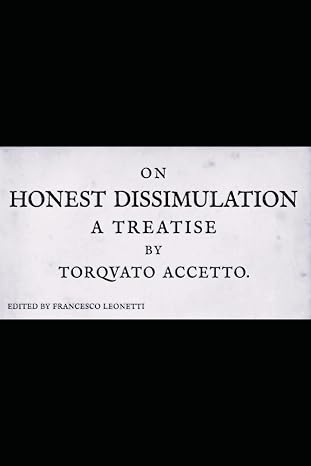
On Honest Dissimulation
Torquato Accetto (1641) · Translated by Francesco Leonetti
The 1641 Italian treatise on the ethics and art of honest concealment — a cornerstone of the reason-of-state tradition, now in English.
Read more →Political Testament
Cardinal Richelieu (1688) · Translated by Antonio García
Richelieu's testament on the art of government, complete in two parts — counsel on statecraft, war, and the administration of a kingdom.
Read more →The Critic (El Criticón), Parts I–III
Baltasar Gracián · Translated by Francesco Leonetti
Gracián's allegorical masterpiece on the journey of life — translated from the 1685 Italian edition.
Read more →The Critic (El Criticón), Parts I–III
Baltasar Gracián · Translated by Antonio García
The same three-part allegory translated from the standard 1913 Spanish text of Julio Cejador.
Read more →The Hero (El Héroe)
Baltasar Gracián (1659) · Translated by Antonio García
Gracián's first book — a manual of the perfect ruler, the first of his art of worldly wisdom.
Read more →The Improved System of the Illuminati
Adam Weishaupt · Translated by Aleksander Bremovych
Adam Weishaupt's complete structural curriculum of the Order — all classes and degrees, from preparation and self-examination through the philosophical systems to the governance of the inner leadership. A crucial primary source on 18th-century political philosophy and pedagogy.
Read more →Writings of the Order of the Illuminati
Adam Weishaupt · Translated by Aleksander Bremovych
The complete English translation of the 1786 Originalschriften — the Order's own writings: the Illuminati cipher, statutes, initiation ceremonies, oaths, membership lists, and internal correspondence. The only English translation of this 1786 collection.
Read more →Original Writings which concern the Illuminati Sect
Adam Weishaupt · Translated by Aleksander Bremovych
Primary-source documents of the Bavarian Illuminati from 1787 — Weishaupt's correspondence on recruitment and leadership, the Order's relationship with Freemasonry, and administrative records including the Diarium and financial ledgers.
Read more →